Introduction
For municipal procurement officers and community project managers, budget constraints are almost always the biggest barrier to launching a solar lighting renovation. Many teams abandon solar solutions after seeing the upfront equipment cost, without realizing that most countries offer dedicated government grants, tax credits and low-interest financing for clean energy public infrastructure.
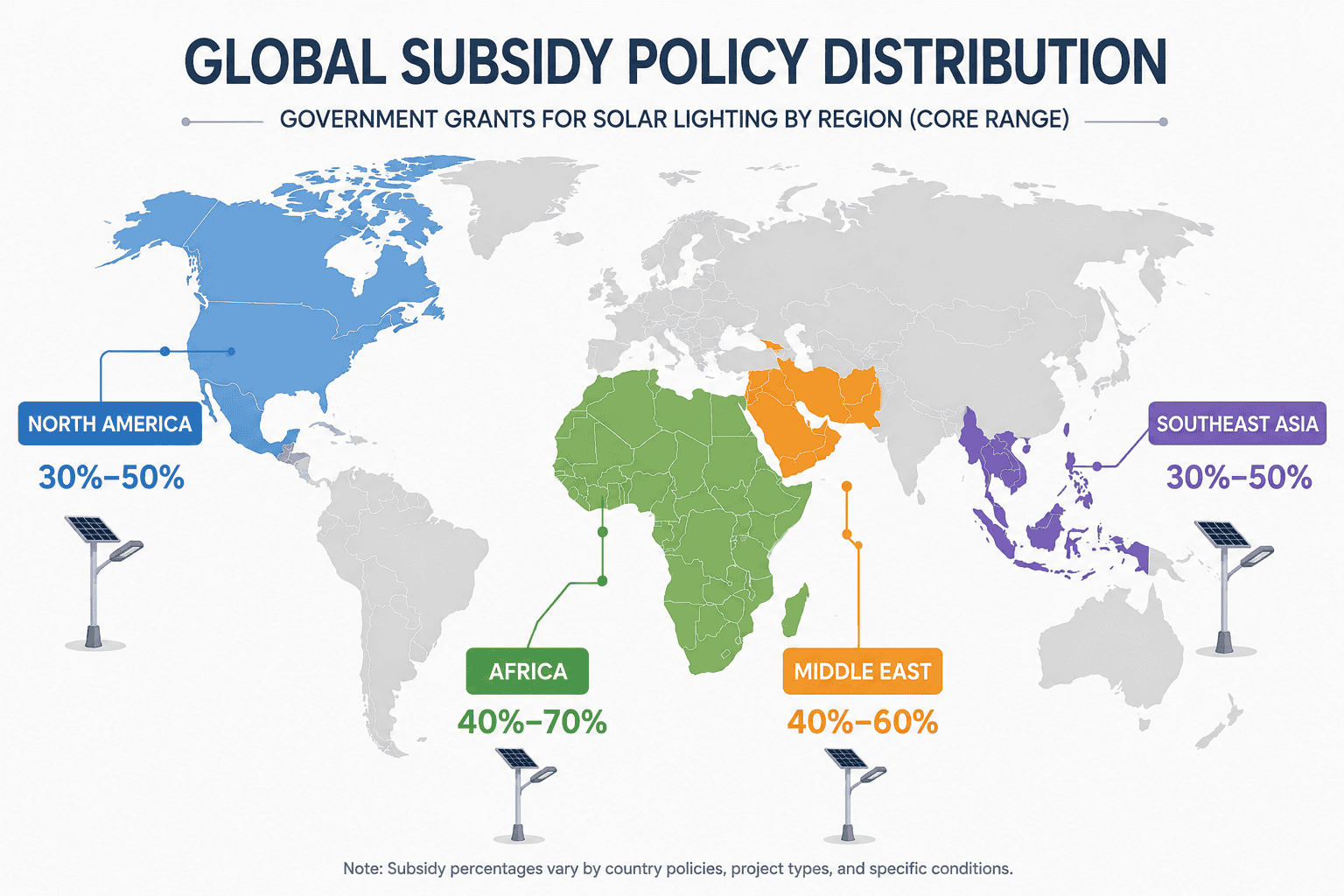
Depending on your region and project type, these incentives can cover 30% to 70% of total project cost, shortening the payback period by 2–3 years. In this guide, we break down the main grant programs across Europe, North America, the Middle East and Southeast Asia, plus a step-by-step application process to help you secure funding successfully.
Why Government Grants Make Solar Lighting Projects More Feasible
Public lighting is one of the most eligible categories for clean energy grants, because it delivers three measurable benefits for governments:
- Reduced carbon emissions
- Lower long-term municipal operating costs
- Improved public safety
Grant funding can directly improve your project economics in three ways:
- Reduce upfront capital expenditure: Direct grants cover 30–50% of equipment and installation cost for most municipal projects.
- Shorten payback period: For projects that would normally take 5–7 years to break even, grants can shorten payback to 2–3 years.
- Expand project scale: With grant support, you can upgrade more roads and public areas within the same base budget.
Many municipal teams miss out on funding simply because they are unaware of available programs, or submit applications without complete technical documentation. Working with an experienced solar lighting supplier can greatly improve your approval rate.
Available Solar Lighting Grants by Major Global Markets
Grant programs vary widely by country and project type. Below we summarize the core active programs in your main target markets.
Europe & North America
Europe has the most mature clean energy funding system, supported by both EU-level and national-level programs.
European Union: The European Green Deal and Recovery and Resilience Facility allocate billions of euros for municipal green infrastructure upgrades. Public lighting energy efficiency retrofits are explicitly listed as a priority eligible category, with funding covering up to 50% of total project investment for qualifying municipalities.
France: The French Environment and Energy Management Agency (ADEME) provides direct investment grants covering up to 40% of solar street lighting installation costs for local governments, under the France Relance green infrastructure program.
Germany: The KfW Development Bank offers preferential low-interest loans for municipal energy efficiency projects, including solar street lighting retrofits, with favorable repayment terms for projects that meet carbon reduction targets.
United States: Under the Inflation Reduction Act (IRA), municipal and public solar lighting projects qualify for a 30% federal Investment Tax Credit (ITC) . Projects located in designated energy communities can receive an additional 10–20% bonus credit. The Department of Energy also runs the Energy Efficiency and Conservation Block Grant (EECBG) program, which provides direct formula grants to local governments for public lighting retrofits.
Additional U.S. funding sources include:
- Community Development Block Grants (CDBG) – HUD-administered grants supporting projects in underserved areas, including solar lighting for public parks and neighborhoods
- State sustainability and resilience grants – Many states offer grants for climate adaptation, storm recovery, or energy modernization, often prioritizing solar lighting for public safety and disaster resilience
- BRIC (Building Resilient Infrastructure and Communities) – FEMA hazard mitigation funding that can cover solar lighting for evacuation routes and critical corridors when tied to mitigation objectives
- Local cost-share programs – Many cities offer direct cost-sharing for solar lighting, such as South Bend, Indiana (homeowners pay $50–250 for solar lampposts) and Creve Coeur, Missouri (50/50 cost share, ~$4,500 per light)
Middle East & GCC Region
Driven by national carbon neutrality visions, Gulf countries are rapidly expanding renewable energy funding for public infrastructure.
Saudi Arabia: Under Saudi Vision 2030, the National Renewable Energy Program (NREP) provides funding support for municipal and rural solar lighting projects, especially in off-grid remote areas. Projects that use locally assembled components qualify for additional priority scoring.
United Arab Emirates: The UAE Energy Strategy 2050 offers targeted grants and tariff incentives for clean energy public projects, including solar street lighting for smart city and rural development initiatives.
Southeast Asia
Southeast Asia is one of the fastest-growing markets for solar lighting grants, focused mainly on rural electrification and public infrastructure upgrading.
Philippines: The Renewable Energy Act (Republic Act No. 9513) provides a full package of fiscal incentives for solar lighting projects: zero VAT on renewable energy equipment, duty-free importation of components, and up to 7 years of income tax holiday for qualifying project entities.
Thailand & ASEAN: The ASEAN Power Grid initiative and national rural electrification programs provide dedicated funding for off-grid solar street lighting in remote villages. Provincial municipal projects can apply for co-funding from both national energy departments and international development banks.
India: The Pradhan Mantri Gram Sadak Yojana-2 program allocates approximately $60 million specifically for rural solar and hybrid street lighting, covering a large share of project cost for village road upgrades through 2028.

Step-by-Step Grant Application Process
While specific requirements vary by program, almost all solar lighting grants follow this standard 5-step workflow.
Step 1: Verify Eligibility and Match the Right Program
First, confirm whether your project meets basic eligibility rules:
- Applicant type: Most public lighting grants are open to municipal governments, public institutions and registered community organizations; private commercial projects usually qualify for tax credits instead of direct grants.
- Project scope: Confirm whether your project location, scale and lighting type are within the fund’s support scope.
- Timeline: Pay attention to application windows — many grant programs open only once or twice per year.
Step 2: Prepare a Complete Technical Project Proposal
Grant committees require detailed technical documentation to evaluate your project. A complete proposal should include:
- Site survey data and lighting layout design
- Clear technical specifications of solar lighting equipment (power, battery capacity, protection grade, etc.)
- Quantifiable expected benefits: annual electricity savings, carbon emission reduction, expected service life
- Detailed project budget breakdown
💡 Tip: Funders look for projects that are both technically feasible and community-driven. The more specific and measurable your project information, the stronger your application will be.
We provide standard technical specification documents and lighting layout design for all our municipal solar lighting solutions, which can be directly used for grant applications.
Step 3: Select a Certified and Qualified Supplier
Almost all grant programs require products to meet local safety and quality certification standards. Choosing an uncertified supplier is the most common reason for application rejection.
Your supplier must be able to provide:
- Valid product certifications (CE, RoHS, and any regional required certificates)
- Official test reports for core components
- Past similar project cases and performance records
All our solar lighting products carry full export certifications and complete test documentation, and we have supported multiple municipal clients in completing grant application materials successfully. You can check our full product range and qualifications on our solar lighting product page.
Step 4: Submit Full Application Documents
Compile all required materials according to the official application guide, including project proposal, supplier qualification documents, budget statement, site ownership certificate and stakeholder support letters.
For most programs, applications are submitted through official online portals. Double-check all data before submission — incomplete or inconsistent information will lead to direct rejection.
Step 5: Project Acceptance and Fund Disbursement
After approval, you will receive a grant agreement specifying the funding amount, disbursement schedule and reporting requirements. Most programs disburse funds in two parts: an advance payment after project launch, and the final balance after completion acceptance and on-site verification.
Common Reasons for Grant Rejection (and How to Avoid Them)
Based on our experience supporting client grant applications, four issues cause most rejections:
- Incomplete technical specifications: Vague product parameters without official test data fail to convince the review committee. Always attach formal supplier technical datasheets.
- Unqualified supplier credentials: Products that lack required local certifications cannot pass compliance review. Confirm certification requirements at the supplier selection stage.
- Unrealistic benefit calculation: Exaggerated energy saving or carbon reduction data will be questioned. Use conservative, verifiable calculation formulas.
- Missing application deadlines: Many programs have strict annual windows. Start preparation at least 2–3 months before the deadline to avoid rushing.
If you want to know more about the long-term economic benefits of solar lighting after grants, you can refer to our complete TCO comparison analysis for detailed 5-year and 10-year cost calculation.
How We Support Your Grant Application
As a professional solar lighting OEM/ODM manufacturer, we provide full document support to help our clients improve grant approval rates:
- Standard certified product datasheets with all technical parameters
- Professional lighting layout design and lux calculation reports
- Complete certification documents and test reports
- Customized project budget and energy saving calculation templates
If you are preparing a solar lighting project and plan to apply for local government grants, welcome to contact our sales support team. Send us your project location, scale and target grant program, and we will prepare matching technical materials for your application.
Final Takeaway
Government grants and incentives can turn a marginally feasible solar lighting project into a highly cost-effective one. The key to success is understanding local policies, preparing complete technical documentation, and working with a certified and experienced supplier.
Even if you do not receive 100% grant funding, partial cost coverage combined with long-term zero electricity bills still makes solar lighting the most economical choice for most public and off-grid projects.