

Introduction
For project managers and financial decision-makers evaluating street lighting renovations, the biggest mistake is only comparing the upfront unit price of lamps. Most grid-powered lighting projects end up costing 2–3 times the initial budget over their service life, due to hidden electricity bills, line maintenance and component replacement costs.
Total Cost of Ownership (TCO) is the only scientific way to evaluate lighting solutions: it calculates all costs from procurement and installation to operation, maintenance and end-of-life replacement over the full project cycle.
In this guide, we break down the 5-year and 10-year TCO of solar and grid-powered street lights with real project data, to help you make accurate budget decisions for municipal, industrial or rural lighting projects.
What Is TCO and Why It Matters for Lighting Projects
TCO (Total Cost of Ownership) refers to the sum of all direct and indirect costs incurred by a product or system throughout its entire service life. For public and industrial lighting projects, upfront procurement usually accounts for less than 30% of the 10-year total cost.
Industry research data indicates that more than 60% of municipal lighting projects significantly underestimate long-term operating costs at the budgeting stage, leading to subsequent budget overruns. This is why more and more project teams use TCO instead of unit price as the core evaluation indicator for supplier selection.
For lighting projects, a complete TCO calculation should include 5 core dimensions:
- Upfront equipment procurement cost
- One-time installation and construction cost
- Annual electricity operating cost
- Annual routine maintenance cost
- Mid-cycle component replacement cost
Full Cost Component Breakdown for Both Solutions
Before comparing the total numbers, we first clarify the composition of each cost item for the two solutions, based on a standard 100PRODUCTS-unit 60W-equivalent municipal road lighting project (10 hours of operation per day).
Cost Structure of Grid-Powered Street Lights
| Cost Category | Details |
|---|---|
| Upfront procurement | Lamp body, pole, cable, transformer and distribution cabinet |
| Installation cost | Trench excavation, cable laying, transformer installation and grid connection procedures — usually accounts for 40–50% of the initial investment |
| Operating cost | Monthly electricity bills, which increase year by year with electricity price adjustments |
| Maintenance cost | Regular line inspection, fault repair, bulb and ballast replacement, requiring professional electricians |
| Replacement cost | Ballast and circuit replacement every 7–8 years |
Cost Structure of Solar Street Lights
| Cost Category | Details |
|---|---|
| Upfront procurement | Lamp body, solar panel, lithium battery, pole and controller |
| Installation cost | Only pole installation and fixing, no wiring or grid connection work — construction period is 50–60% shorter than grid-powered solutions |
| Operating cost | Zero electricity bill for life |
| Maintenance cost | Only regular solar panel cleaning and annual battery status check, no professional circuit maintenance required |
| Replacement cost | Battery replacement once around the 5th–6th year of use |
You can check the standard configuration and parameter details of different power models on our solar lighting product collection page.
5-Year & 10-Year TCO Side-by-Side Data Comparison
Calculation Benchmark Assumptions
| Parameter | Value |
|---|---|
| Project scale | 100 sets of 60W-equivalent road lamps |
| Daily lighting time | 10 hours |
| Local electricity price | $0.12/kWh *(Note: In regions with higher electricity prices such as Europe ($0.20–0.30/kWh), the cost advantage of solar lighting becomes even more significant.)* |
| Construction labor cost | $80/person/day |
| Lamp pole cost | Excluded (same for both solutions) |
5-Year TCO Comparison Table
| Cost Item | Grid-Powered Street Light | Solar Street Light |
|---|---|---|
| Upfront Equipment Procurement | $8,200 | $17,800 |
| One-Time Installation Construction | $14,500 (trenching + cabling + grid connection) | $4,800 (pole mounting only, no wiring) |
| 5-Year Total Electricity Cost | $13,140 | $0 |
| 5-Year Total Maintenance Cost | $6,200 | $1,900 |
| 5-Year Component Replacement Cost | $1,100 (bulb replacement) | $0 |
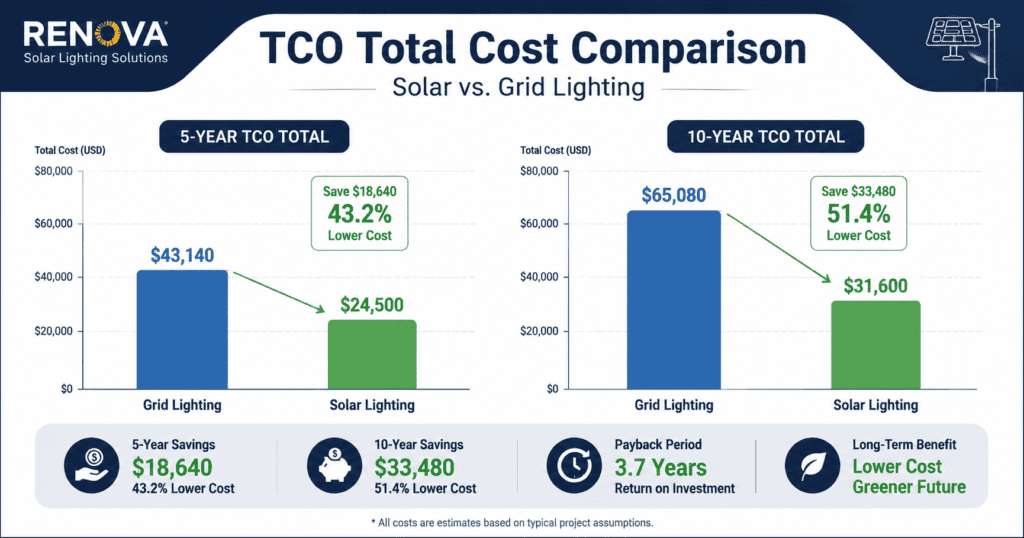
| ✅ 5-Year Total TCO | $43,140 | $24,500 |
10-Year TCO Comparison Table
| Cost Item | Grid-Powered Street Light | Solar Street Light |
|---|---|---|
| 10-Year Total Electricity Cost | $26,280 | $0 |
| 10-Year Total Maintenance Cost | $12,700 | $3,800 |
| 10-Year Component Replacement Cost | $3,400 (ballast + circuit repair) | $5,200 (battery replacement in Year 6) |
| ✅ 10-Year Total TCO | $65,080 | $31,600 |
Key Findings
Industry research data indicates that solar lighting solutions achieve cost payback within 3–5 years on average for most municipal and industrial projects, and the longer the service life, the higher the cost savings.
In the above benchmark scenario:
- Payback period of solar street lights: ~3.7 years
- 10-year total cost savings: 51.4% lower than grid-powered lighting ($33,480 saved)
Our lithium iron phosphate energy storage batteries have an extended cycle life of more than 3,000 charges, which can further delay the battery replacement cycle and reduce the 10-year TCO by an additional 6–8%.
Key Variables That Affect Your Actual TCO Result
The above data is a general benchmark. The actual cost gap between the two solutions will be larger or smaller depending on your specific project conditions.
1. Distance from the Power Grid
The farther the project site is from the existing grid, the higher the cable laying and transformer cost of grid-powered lighting. For rural roads, industrial parks and mining areas more than 500 meters away from the grid, the initial installation cost of grid lighting will increase by 2–3 times, and the payback period of solar lighting can be shortened to less than 2 years.
2. Local Electricity Price
In regions with high electricity prices such as Europe and the Middle East, the annual electricity cost of grid lighting is higher, and the cost advantage of solar lighting is more obvious. In low electricity price regions, it is necessary to combine the project scale and service cycle to calculate the return.
3. Local Annual Sunshine Duration
Sufficient sunshine can extend battery life and reduce maintenance frequency. For tropical regions with more than 2,500 hours of annual sunshine, the actual service life of solar panels and batteries is 15–20% longer than the standard value.
According to international research on emerging market infrastructure, for off-grid rural lighting projects, solar solutions can reduce the total 10-year project investment by 45–60% compared with extending the power grid, making it the most economical solution currently available.
How to Optimize Solar Lighting TCO for Your Project
To maximize the cost saving effect of solar lighting projects, you can start from three aspects in the early selection stage:
- Customized configuration according to local climate: Adjust battery capacity and panel power according to local rainy season duration and sunshine hours to avoid over-configuration waste or under-configuration affecting stability.
- Professional lighting layout design: Reasonable lamp spacing and installation height can reduce the total number of lamps by 10–15% on the premise of meeting brightness standards, reducing upfront investment.
- Choose a factory with stable product quality: High-quality products can reduce later maintenance and replacement costs. Inferior low-cost products often need to replace batteries in the second or third year, which actually increases the total TCO instead.
Our team provides free pre-project TCO calculation and lighting layout design services. You can tell us your project scale, local climate and electricity price parameters through our contact page, and we will provide you with an exclusive cost budget plan within 24 working hours.
You can also refer to our Thailand rural solar project case study to view the actual operating cost data of real landed projects.
Final Takeaway for Decision-Makers
Solar street lights have a higher upfront unit price, but their zero electricity cost and low maintenance characteristics make their full life cycle cost far lower than that of grid-powered lighting for most medium and long-term projects. For projects with a service cycle of more than 3 years, especially off-grid and remote sites, solar lighting is almost always the more cost-effective choice.
If you are preparing a lighting project budget and need more accurate cost calculation, welcome to contact our technical sales team for a free customized TCO analysis report.


