
Introduction
If you are exploring solar lighting for your project for the first time, you have probably heard all kinds of conflicting opinions: “They die as soon as it rains”, “They are nowhere near as bright as normal street lights”, “They cost a fortune and break quickly”.
Many of these myths come from early low-quality solar products from 10+ years ago, or from buyers who chose unregulated cheap suppliers. With today’s lithium battery technology and high-efficiency photovoltaic panels, modern solar street lights have long outperformed those old impressions.
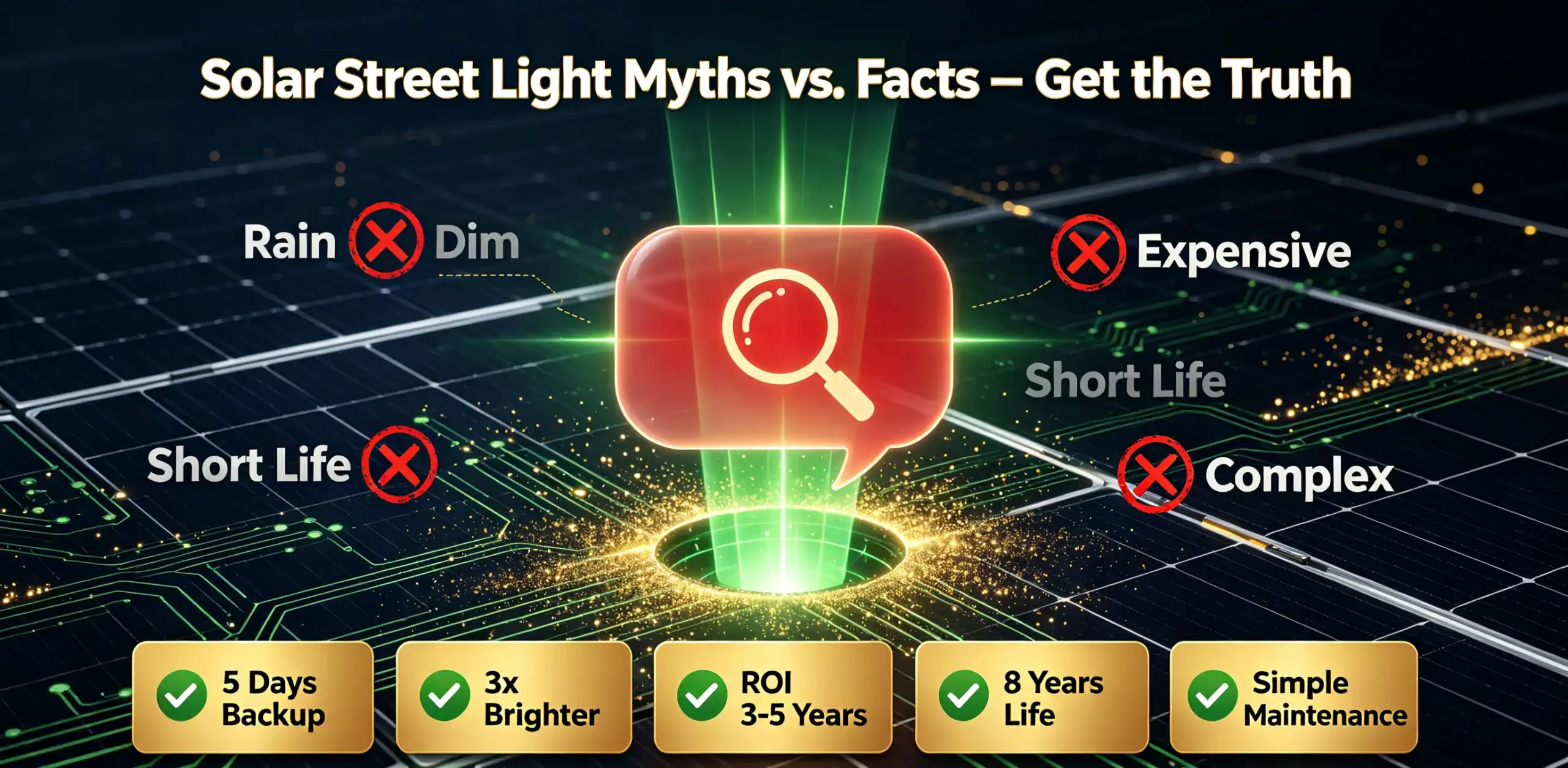
In this guide, we break down the 5 most widespread myths about solar street lights, explain the real technical facts, and help you make the right procurement decision without being misled by outdated rumors.

Myth 1: Solar Street Lights Stop Working on Rainy or Cloudy Days
Where This Myth Comes From
This is the most common worry for buyers in rainy tropical regions. Early solar street lights used small-capacity lead-acid batteries and low-efficiency panels, which would run out of power after 1–2 cloudy days, leaving roads dark at night.
The Real Facts
Modern high-quality solar street lights are designed to work stably through long rainy seasons.
First, solar panels can still generate electricity on cloudy days — they just produce 20–30% of their full-sun output, which is enough to supplement battery power. Second, most formal factory products are equipped with lithium iron phosphate batteries that support 3–7 days of autonomous lighting without full sun.
Our split solar street lights use extra-large capacity energy storage batteries and intelligent dimming mode, which can maintain normal full-night lighting for up to 5 consecutive rainy days. All lamp bodies reach IP67 waterproof grade, so heavy rain and high humidity will not damage internal circuits.
For buyers in Southeast Asia, Africa and other regions with long monsoon seasons, you only need to inform your supplier of local rainy season duration in advance, and they can adjust battery capacity to match the climate — there is no need to worry about power failure at all.
Myth 2: Solar Street Lights Are Much Dimmer Than Grid-Powered Electric Lights
Where This Myth Comes From
Many people compare low-power small solar garden lights with municipal high-voltage sodium lamps, and conclude that “solar lights are dim”. There are also many cheap products on the market that falsely mark power parameters, resulting in actual brightness far lower than advertised.
The Real Facts
When configured with the same actual lighting demand, modern LED solar street lights can fully reach or even exceed the brightness of traditional grid-powered sodium lamps.
Traditional high-pressure sodium lamps have very low light efficiency — only about 30% of the electricity is converted into visible light. High-brightness LED chips used in solar street lights have a light efficiency 3–4 times higher than sodium lamps. In actual projects, a 60W solar LED street light can achieve the same road illumination effect as a 150–180W traditional sodium lamp.
You can check the specific parameters and application effects of different power models on our full solar lighting product page. All our product power parameters are real standard values, and we provide professional lighting layout design to ensure that the road brightness fully meets your local municipal standards.

Myth 3: Solar Street Lights Are Too Expensive and Not Cost-Effective
Where This Myth Comes From
Buyers often only look at the upfront unit price of a single lamp, and conclude that solar lights are more expensive than ordinary electric street lights. They ignore the hidden costs of grid-powered lighting systems.
The Real Facts
If you calculate the total cost over the full 5–10 year service cycle, solar street lights are almost always more cost-effective than grid-powered ones, especially in areas without ready grid access.
For grid-powered street lights, you need to pay for cable laying, transformer installation, road excavation and construction labor — these construction costs can even exceed the price of the lamps themselves. After delivery, you also have to pay monthly electricity bills and regular line maintenance fees.
Solar street lights have zero electricity bills after installation, and no wiring construction costs for off-grid projects. According to IEA data on off-grid photovoltaic applications, most municipal solar lighting projects achieve full cost recovery within 3–5 years, and save a large amount of operating expenses in the subsequent service life.
For rural roads, industrial parks and remote sites far from the power grid, choosing solar lighting can save 40–60% of the total 10-year project cost. You can learn more about cost calculation for different scenarios on our municipal solar lighting solutions page.
Myth 4: Solar Street Lights Have a Very Short Service Life
Where This Myth Comes From
A large number of ultra-low-cost solar lights on the market use inferior second-hand batteries and low-quality chips, which fail after 1–2 years of use. Many buyers who have purchased these cheap products form the impression that “solar lights break easily”.
The Real Facts
The service life of solar street lights depends entirely on product quality and configuration. Products from regular professional factories have a very long service life.
- LED lamp beads: High-quality brand chips have an average rated life of 50,000–80,000 hours, which means they can be used normally for 10+ years even if lit for 10 hours every night.
- Solar panels: Monocrystalline silicon panels have an attenuation rate of less than 2% per year, and their effective service life can reach 20–25 years.
- Energy storage battery: High-quality lithium iron phosphate batteries have a cycle life of more than 3000 charges and discharges, and can be used stably for 5–8 years under normal use.
In short, if you choose a formal OEM/ODM solar lighting factory instead of blindly pursuing the lowest price, the whole set of solar street lights can operate stably for 5–8 years, and only need to replace the battery once in the middle to continue using it.
Myth 5: Solar Street Lights Require Frequent and Complicated Maintenance
Where This Myth Comes From
People associate solar street lights with complex photovoltaic power station maintenance, or worry that batteries and panels need frequent professional repair.
The Real Facts
Modern integrated and split solar street lights adopt modular design, and the daily maintenance workload is far lower than that of grid-powered street lights.
Grid-powered street lights require regular inspection of line aging, transformer faults and short circuit risks, especially in rainy seasons, which have high safety hazards and require professional electricians to maintain.
Solar street lights have no external wiring, and the daily maintenance is extremely simple:
- Wipe the dust on the surface of the solar panel once every 2–3 months (rain can also clean it automatically in rainy areas)
- Check the battery status once a year
- If a single lamp fails, you only need to replace the corresponding modular part, no need to adjust the whole line
You can find more daily maintenance tips in our solar light FAQ page. For bulk project clients, we also provide complete maintenance training and spare parts supply services to reduce your later operation pressure.

Final Thoughts: Choose the Right Supplier, Not the Lowest Price
Almost all of these 5 myths are caused by low-quality inferior products on the market. For formal professional solar lighting factories, these problems have been solved through technical upgrading and standardized production.
When you select solar street light suppliers, don’t just judge by price. Pay more attention to battery configuration, protection grade, factory certification and actual project cases — these are the key factors that determine whether the product can be used stably for a long time.
If you still have doubts about solar lighting selection, configuration or customization, welcome to contact our sales team for free consultation. We can provide targeted product recommendations and project cost budgets according to your actual use scenario and local climate.
You can also browse more technical guides and maintenance on our blog to learn more about solar lighting procurement knowledge.


